I’ve always liked the little red stamps found in Asian paintings and I’ve wanted to incorporate something similar into my own artwork.
In Japanese and Chinese paintings the seals often identify the artist, owners, collectors, and/or other individuals associated with the artwork over time.
For my own work, I wanted to use African symbols that speak to the core principals of deep ecology, an environmental philosophy that argues that nature has intrinsic value regardless of its utility to humans.
The deep ecology movement has always resonated with me, as I believe the well-being of future generations hinges upon the creation of a more sustainable human existence, one that is in balance with the natural world.
There are eight principles to the deep ecology movement. These are:
- The well-being and flourishing of human and non-human life on Earth have value in themselves. These values are independent of the usefulness of the non-human world for human purposes.
- Richness and diversity of life forms contribute to the realization of these values and are also values in themselves.
- Humans have not right to reduce this richness and diversity except to satisfy vital needs.
- The flourishing of human life and cultures is compatible with a substantially smaller human population. The flourishing of non-human life requires a smaller human population.
- Present human interference with the non-human world is excessive, and the situation is rapidly worsening.
- Policies must therefore be changed. There policies effect basic economic, technological, and ideological structures. The resulting state of affairs will be deeply different from the present.
- The ideological change will be mainly that of appreciating life quality rather than adhering to an increasingly higher standard of living. There will be a profound awareness of the difference between bigness and greatness.
- Those who subscribe to the foregoing points have an obligation directly or indirectly to try to implement the necessary changes. (Naess 264)
People may interpret these principals as extreme measures, but nearly every credible scientist studying planetary well-being (e.g., climate change, pollution, ecological overshoot, over population, etc.) has warned that extreme measures are needed to achieve sustainability and avoid or at least mitigate environmental catastrophes.
With DFA #1 (aka “Tobias,” or the elephant drawing), I tried to convey the ineffable and inimitable beauty of the African elephant. With the symbols within the stamps, I attempt to communicate what we, that is, humans collectively, must do to preserve this beauty in perpetuity.
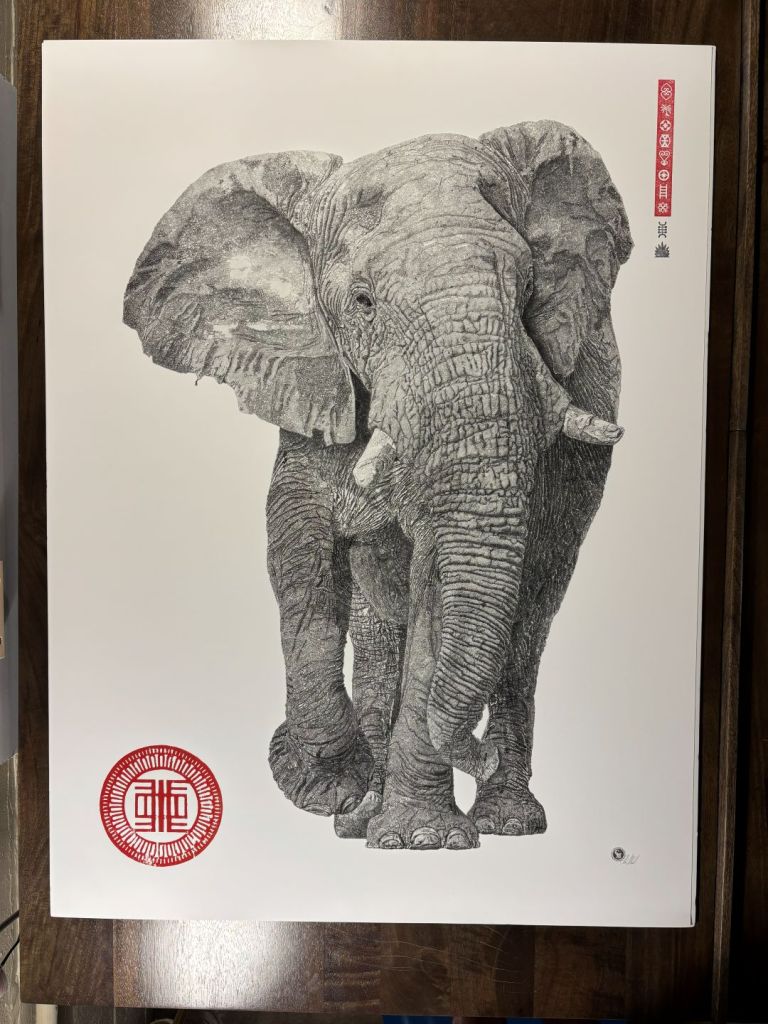
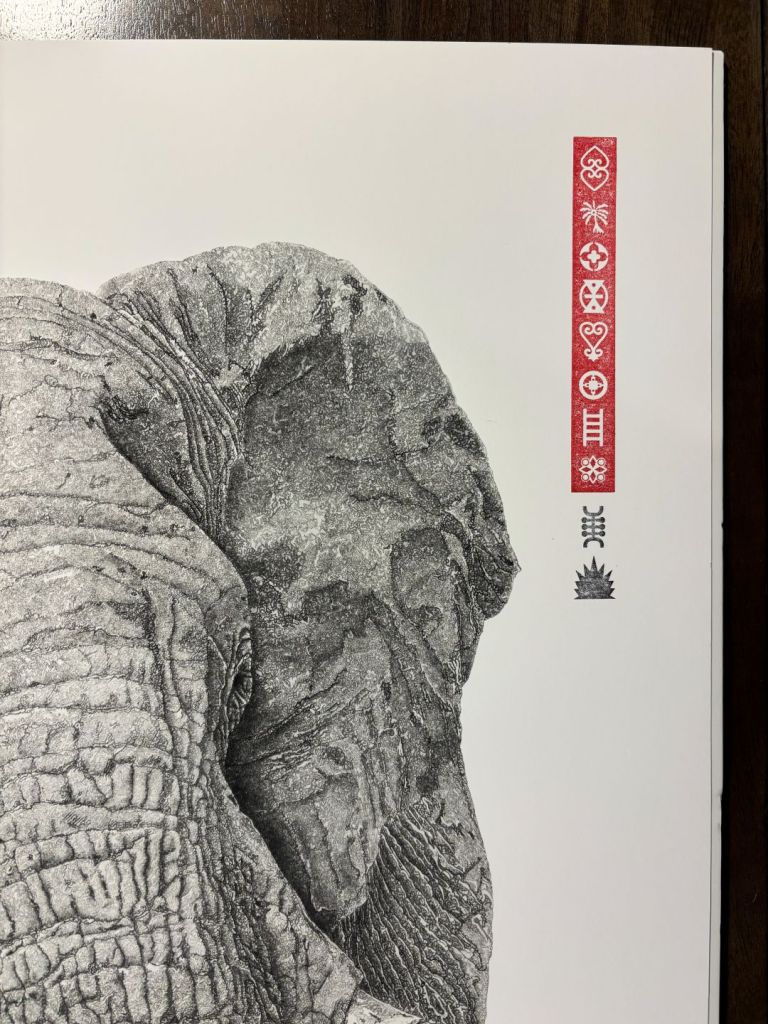
The stamps contains Adinkra symbols. These are traditional African symbols that convey wisdom and values. The first collection of eight symbols, colored in red ink, speak directly to the principals of deep ecology. The two additional symbols, colored in black ink below the red symbols, are powerful human qualities we must leverage to successfully integrate elements of the eight principals into our way of life. The meanings of the symbols are described below in the same order in which they appear in the stamp, from top to bottom:
- First red symbol: Asase Ye Duru – This symbol reminds us of the significance off the Earth as a giver of life and resources. It urges us to respect and honor the earth, acknowledge our responsibility to care for and sustain its resources for future generations (Duncan 83).
- Second red symbol: Abe Dua – This symbol is a powerful reminder of the richness and abundance of our natural surroundings and underlines the importance of living in harmony with nature (Duncan 45).
- Third red symbol: Asennua – This symbol signifies the capcity to prioritize others before ourselves, to make sacrifices for the greater good, and to embody the spirit of unconditional love (Duncan 85).
- Fourth red symbol: Mmere Dane – It encourages individuals to be flexible, open-minded, and willing to adapt to new circumstances. It also symbolizes the recognition of evolution as an integral part of life. It enables individuals to embrace flexibility, adaptability, and a willingness to evolve to thrive in a dynamic world (Duncan 175).
- Fifth red symbol: Sankofa – The bird is the visual representation of ..looking back into the past, retrieving valuable knowledge, wisdom, and lessons, and using them to guide and shape the future (Duncan 293).
- Sixth red symbol: Dame Dame – This symbol serves as a reminder to foster an open and innovative mindset, challenging established norms and embracing the possibilities of change and growth (Duncan 103).
- Seventh red symbol: Owuo Atwedee – This symbol encourages individuals to appreciate life’s preciousness, make the most of their time, and prioritize what truly matters (Duncan 283).
- Eighth red symbol: Esono Anantam – This symbol encourages one to reflect on their values, passions, and strengths. It catalyzes personal growth, inspiring individuals to engage in meaningful endeavors and contribute to the betterment of society (Duncan 121).
- First black symbol: Osidan – This symbol serves as a call to channel one’s creative energies, explore innovative pathways, and contribute unique perspectives to various aspects of life. This symbol encourages individuals to recognize their potential for creativity and use it to bring about positive change and progress (Duncan 273).
- Second black symbol: Awia Repue – This is a powerful symbol of hope, reminding us that no matter what happened yesterday, a new day brings the opportunity for change, growth, and improvement (Duncan 89).
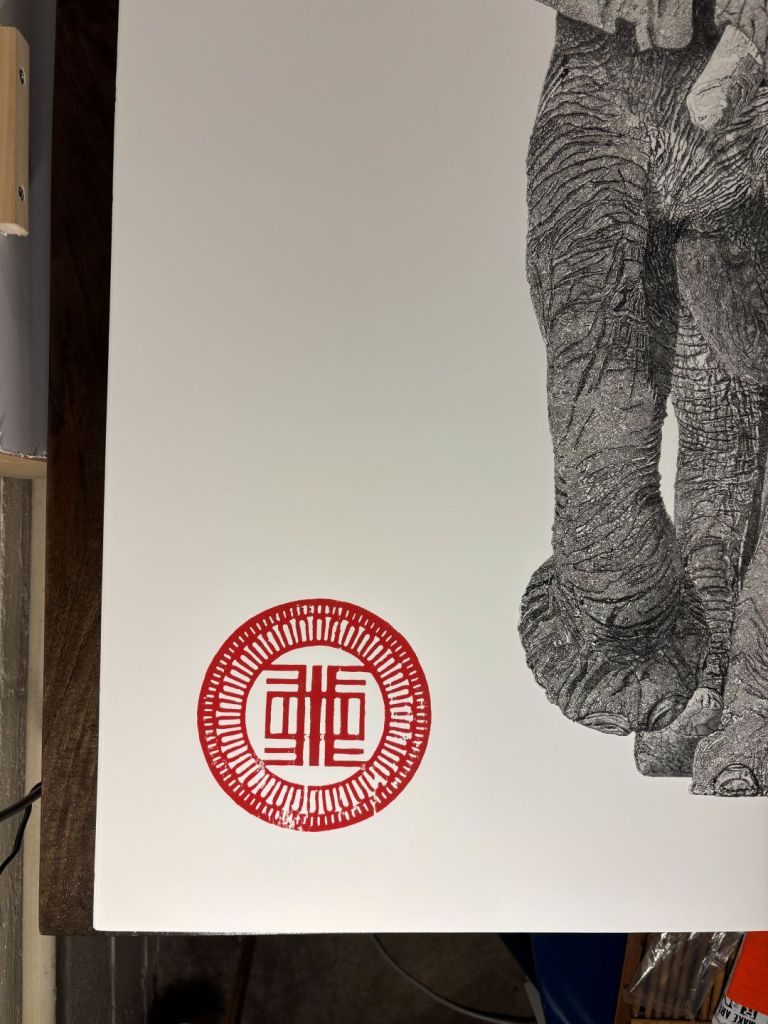
In the lower left corner of the artwork, is a woodblock print. I carved the symbol from a block of poplar wood. The central symbol is called Nea Onnim No Sua A Ohu. It encourages individuals to embrace a lifelong learning mindset and emphasizes the importance of seeking knowledge, expanding one’s understanding, and remaining open to new ideas and perspectives (Duncan 189).
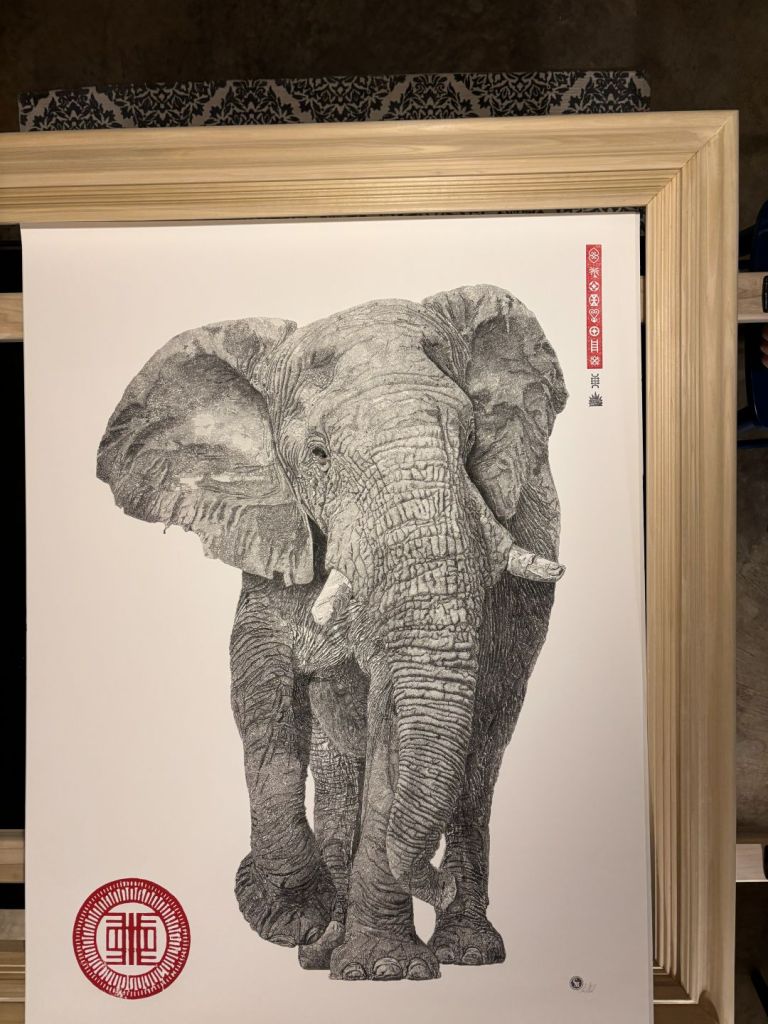
Here’s the completed artwork loosely positioned within one of my “in progress” frames. The frame is for another painting, but the picture depicts how the artwork will look framed.
Thanks for reading!
Naess, Arne. “The Deep Ecology Movement: Some Philosophical Aspects.” Environmental Ethics: An Anthology, edited by Andrew Light and Holmes Rolston III, [Blackwell Publishing Ldt], [2003], p. 264.
Duncan, Nakia. Wisdom Without Words: Adinkra Symbols: The Modern Guide. Nakia Duncan, 2023.

